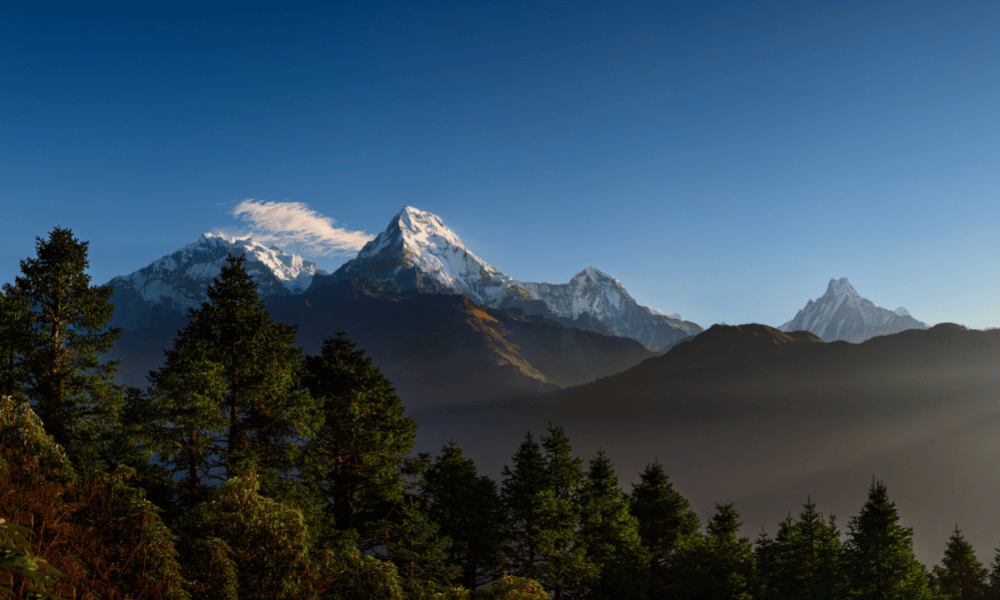
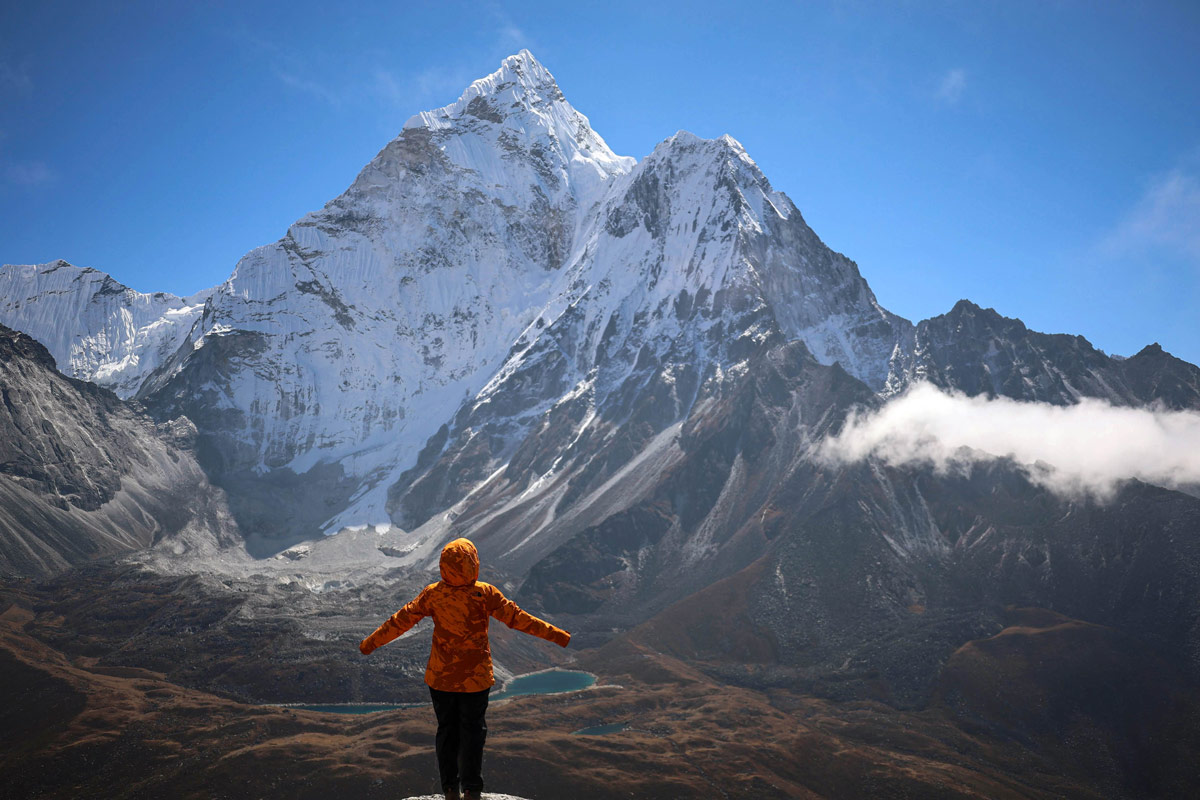
The magnificent views of the world’s highest peak, Mt.
Everest (8,848.68m)
World’s highest airport at Syangboche (3,780m)
Explore a wide range of flora and fauna at Sagarmatha National
Park
Wildlife like musk deer, colorful
pheasants,
snow leopards, and Himalayan Tahrs
Chance to explore the culture and lifestyles of the local
Sherpa people
Prayer wheels, colorful flags, Mani stones, and high suspension bridges
Visit an ancient monastery in Tengboche
Highest glacier on Earth — Khumbu Glacier (4,900m)
Amazing panoramic views from Kala Patthar (5,555m)
Views of other peaks such as Mt. Lhotse (8,516m),
Cho Oyu (8,201m), and Mt. Makalu (8,463m)
Everest Base Camp Trek Overview
Experience the ultimate convenience o
n your Everest Base Camp
trek with our carefully curated itinerary,
offering an EBC trek with helicopter return option.
Designed for those seeking to optimize their
time and avoid the arduous hike back to Lukla,
this perfect plan allows you to relish the beauty
of the popular Everest Base Camp trail on foot
and then
conclude your adventure with a thrilling Helicopter
flight from Gorakshep to Lukla.
Prepare for an unforgettable journey as you soar high above the Himalayan
wonders, making your
EBC trek
truly extraordinary.
Everest base camp trek with helicopter return introduces
you to the world’s highest peak as well as the culture and traditions of
Nepal. This 12 day trek to Everest Base Camp will take you
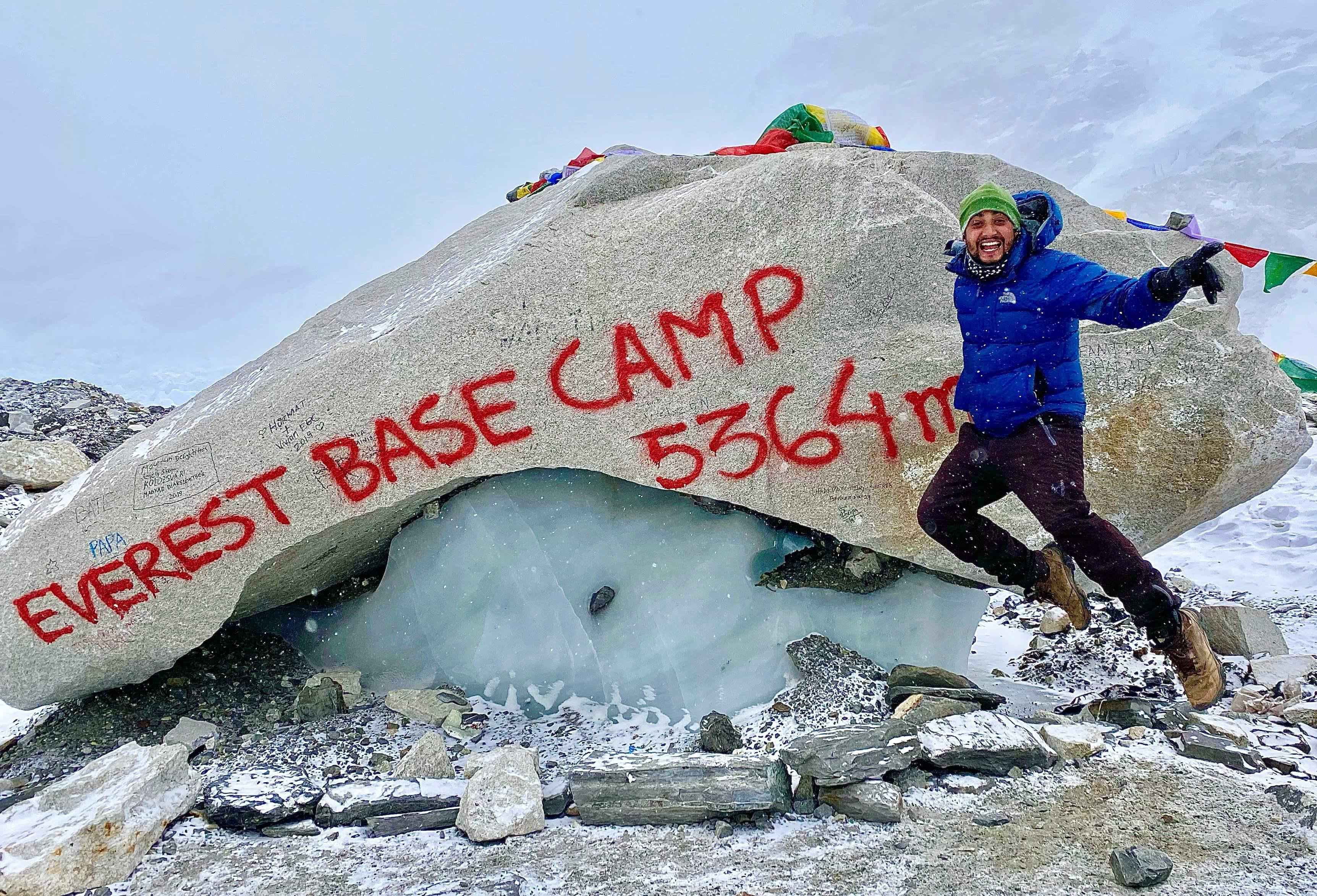
to a height of roughly 5,364 meters.
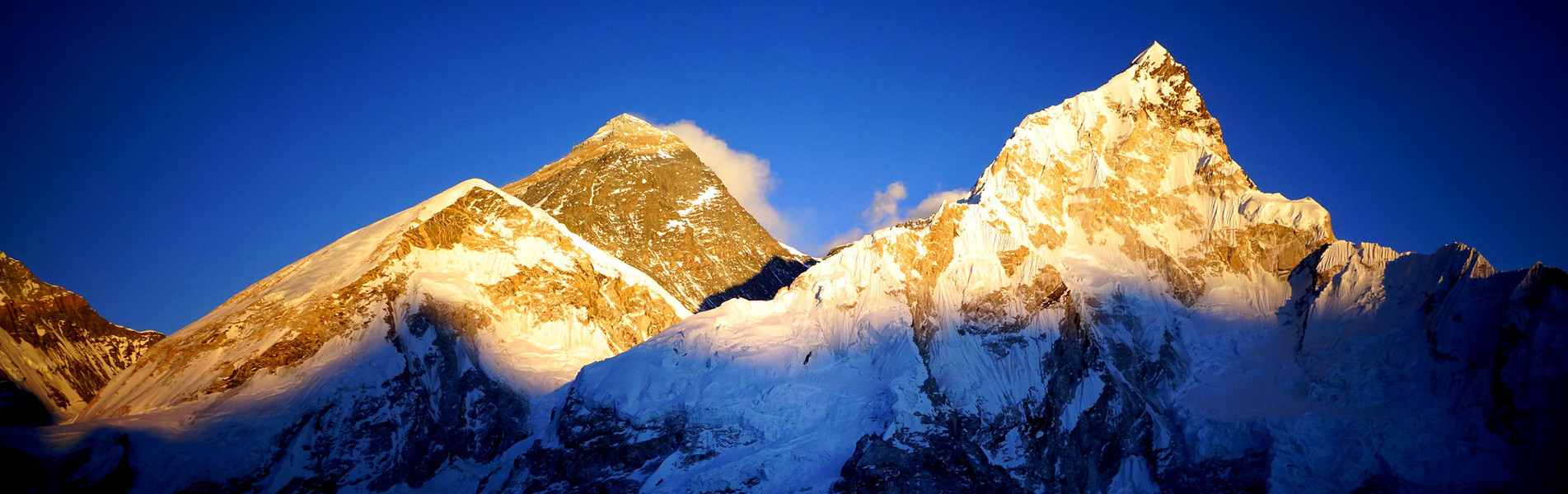
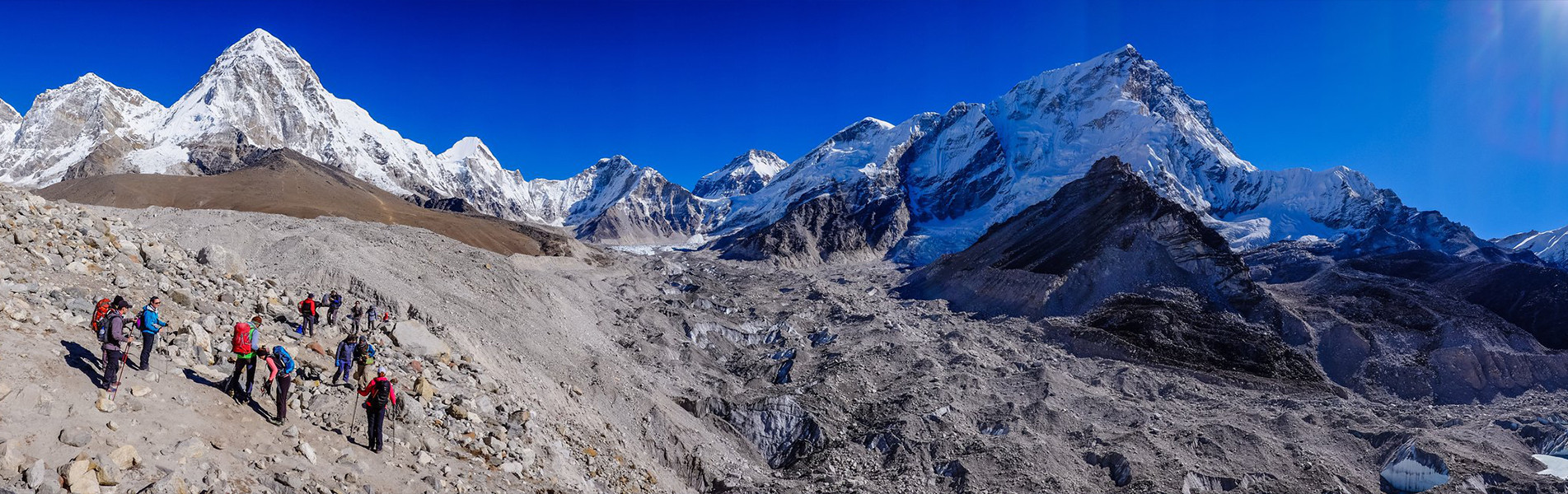
It provides panoramic views of many 8,000-meter-high summits.
You can witness the incredible view of Pumori,
Lhotse, Nuptse, Lobuche as well as the iconic Mt. Everest
itself.
The Everest base camp trek with h
elicopter return begins and ends in
Lukla. The journey starts along the
Dudh Koshi River’s bank, passing through the Sagarmatha National Park
on the way to Namche Bazaar. Namche Bazaar
is the main trading point in the Everest region and is known as an
acclimatization destination.
Everest Base Camp Trek Short Itinerary
Day 01:
in Kathmandu
(1,400 m / 4,593
ft) and transfer to hotel.
Overnight at a 3-star hotel.
Day 02:
Fly to Lukla (2,840 m / 9,318 ft) from
Kathmandu (1,400 m / 4,593 ft) – 35 minutes
or drive to Manthali/Ramechhap (474 m / 1,555 ft)
by shared tourist vehicle – 5 to 6 hours and a
20-minute flight to Lukla (2,840 m / 9,318 ft),
and then trek to
Phakding (2,610 m / 8,563 ft) – 3 to 4
hours. Overnight at a guesthouse.
Day 02:
in Kathmandu
(1,400 m / 4,593
ft) and transfer to hotel.
Overnight at a 3-star hotel.
Everest Base Camp Trek Departures for 2026 & 2027
calendar
Everest Base Camp Trek Itinerary
1
Day 01:
in Kathmandu and transfer to hotel/
Max. Altitude:
1,400 m / 4,593 ft
Accomodation:
Overnight in Kathmandu
Meals:
Not Included
Transportation:
Private Vehicle
Duration:
6.2km / 3.8miles
Elevation Gain:
6.2km / 3.8miles
Elevation Loss:
6.2km / 3.8miles
Distance:
6.2km / 3.8miles
Experience the ultimate convenience o
n your Everest Base Camp
trek with our carefully curated itinerary,
offering an EBC trek with helicopter return option.
Experience the ultimate convenience o
n your Everest Base Camp
trek with our carefully curated itinerary,
offering an EBC trek with helicopter return option.
The magnificent views of the world’s highest peak, Mt.
Everest (8,848.68m)
World’s highest airport at Syangboche (3,780m)
Explore a wide range of flora and fauna at Sagarmatha
National
Park
Wildlife like musk deer, colorful
pheasants,
snow leopards, and Himalayan
Tahrs
Chance to explore the culture and lifestyles of the local
Sherpa people
Prayer wheels, colorful flags, Mani stones, and high suspension
bridges
Visit an ancient monastery in Tengboche
Highest glacier on Earth — Khumbu Glacier
(4,900m)
Amazing panoramic views from Kala Patthar
(5,555m)
Views of other peaks such as Mt. Lhotse
(8,516m),
Cho Oyu (8,201m), and Mt.
Makalu (8,463m)
2
Day 02: Fly to Lukla from Kathmandu or drive to Manthali (Ramechhap) and
a flight to Lukla, and then trek to Phakding
Experience the ultimate convenience o
n your Everest Base Camp
trek with our carefully curated itinerary,
offering an EBC trek with helicopter return option.
Experience the ultimate convenience o
n your Everest Base Camp
trek with our carefully curated itinerary,
offering an EBC trek with helicopter return option.
The magnificent views of the world’s highest peak, Mt.
Everest (8,848.68m)
World’s highest airport at Syangboche (3,780m)
Explore a wide range of flora and fauna at Sagarmatha
National
Park
Wildlife like musk deer, colorful
pheasants,
snow leopards, and Himalayan
Tahrs
Chance to explore the culture and lifestyles of the local
Sherpa people
Prayer wheels, colorful flags, Mani stones, and high suspension
bridges
Visit an ancient monastery in Tengboche
Highest glacier on Earth — Khumbu Glacier
(4,900m)
Amazing panoramic views from Kala Patthar
(5,555m)
Views of other peaks such as Mt. Lhotse
(8,516m),
Cho Oyu (8,201m), and Mt.
Makalu (8,463m)
3
Day 03: Trek to Namche Bazaar from Phakding
Experience the ultimate convenience o
n your Everest Base Camp
trek with our carefully curated itinerary,
offering an EBC trek with helicopter return option.
Experience the ultimate convenience o
n your Everest Base Camp
trek with our carefully curated itinerary,
offering an EBC trek with helicopter return option.
The magnificent views of the world’s highest peak, Mt.
Everest (8,848.68m)
World’s highest airport at Syangboche (3,780m)
Explore a wide range of flora and fauna at Sagarmatha
National
Park
Wildlife like musk deer, colorful
pheasants,
snow leopards, and Himalayan
Tahrs
Chance to explore the culture and lifestyles of the local
Sherpa people
Prayer wheels, colorful flags, Mani stones, and high suspension
bridges
Visit an ancient monastery in Tengboche
Highest glacier on Earth — Khumbu Glacier
(4,900m)
Amazing panoramic views from Kala Patthar
(5,555m)
Views of other peaks such as Mt. Lhotse
(8,516m),
Cho Oyu (8,201m), and Mt.
Makalu (8,463m)
4
Day 04: Acclimatization Day at Namche. Hike to Hotel Everest View and
back
Trekking without proper acclimatization at a higher elevation
can lead to mountain altitude sickness and other severe illnesses.
Thus, it’s
better for you to spend an acclimatization day before you embark
on high-altitude stops.
Experience the ultimate convenience o
n your Everest Base Camp
trek with our carefully curated itinerary,
offering an EBC trek with helicopter return option.
The magnificent views of the world’s highest peak, Mt.
Everest (8,848.68m)
World’s highest airport at Syangboche (3,780m)
Explore a wide range of flora and fauna at Sagarmatha
National
Park
Wildlife like musk deer, colorful
pheasants,
snow leopards, and Himalayan
Tahrs
Chance to explore the culture and lifestyles of the local
Sherpa people
Prayer wheels, colorful flags, Mani stones, and high suspension
bridges
Visit an ancient monastery in Tengboche
Highest glacier on Earth — Khumbu Glacier
(4,900m)
Amazing panoramic views from Kala Patthar
(5,555m)
Views of other peaks such as Mt. Lhotse
(8,516m),
Cho Oyu (8,201m), and Mt.
Makalu (8,463m)
Max. Altitude: Kathmandu (1,400 m / 4,593 ft)
Overnight in Kathmandu
Meals not included
Duration: 5-6 hrs trek
Inclusions in the Everest Base Camp Trek
Accommodation
Twin-sharing/double accommodation in a 3-star hotel for
2 nights in Kathmandu including breakfast (Private room
accommodation can be
organized at an extra cost).
Twin-sharing guesthouse
accommodation during the trek
for 11 nights in the Everest Region with
attached bathrooms in Lukla, Phakding & Namche.
Meals & Drinking Water
All your standard meals during the trek (11 Breakfasts,
11 Lunches and 11 Dinners) including a tea or coffee.
Fresh seasonal fruits each day after dinner during the trek.
A farewell dinner on the last night in Nepal.
Purified drinking water during the trek using Water Filter
or water purification tablets.
Guide & Staff
Experienced, first-aid trained, government licensed,
English speaking, and locally recruited trekking guide
(2 guides for group size more than 7 people).
Porters during the trek for carrying luggage
(1 porter for every 2 clients).
Wages, accommodation,
meals, gear, insurance and
medications for all staff.
Excludes in the Everest Base Camp Trek
Lunch and dinner in Kathmandu.
International flight fare and airport departure tax.
Nepal Entry Visa (Visa can be acquired easily after your arrival at
Tribhuvan International Airport in Kathmandu with a fee of USD 30 for 15
days visa, USD 50 for 30 days visa and USD 125 for 90 days visa).
Travel insurance along with high-altitude emergency evacuation coverage.
Any beverages including bottled and boiled water.
Tips to trekking staff and driver.
Personal trekking gear and equipment.
Any expenses other than the Price Include section.
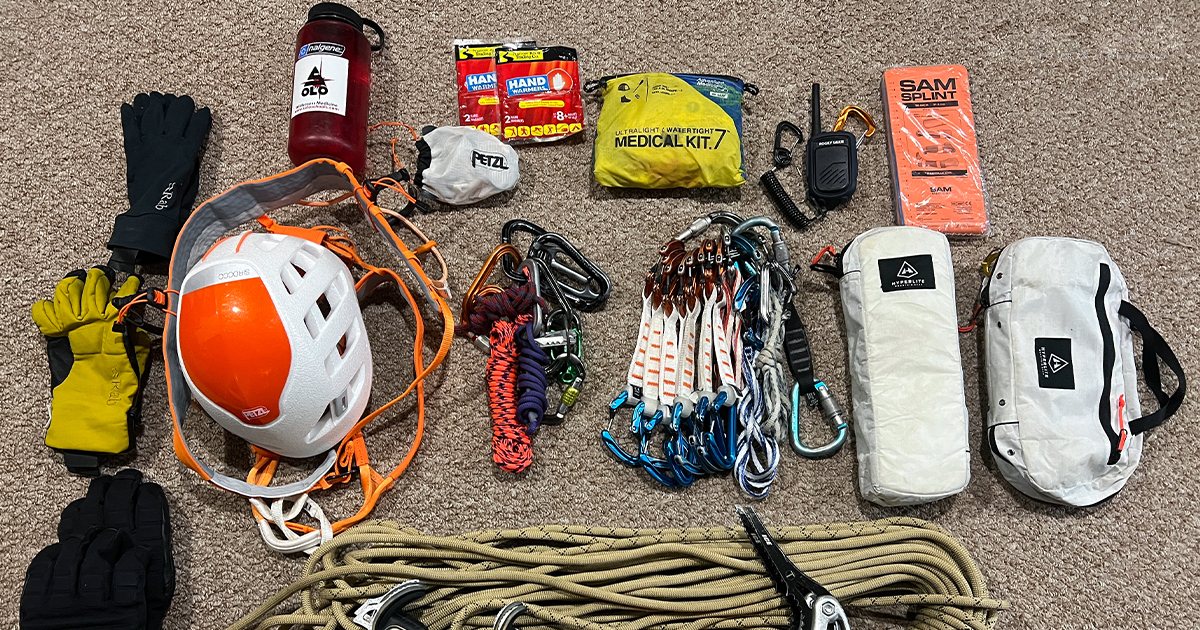
Equipment List Of Everest Base Camp Trek
Success and comfort on your Ama Dablam Expedition hinge
on proper preparation,
and your equipment list is central to this. This comprehensive guide
outlines
every essential item, from high-performance apparel to specialized trekking
tools, ensuring your safety and readiness for the diverse Himalayan
environment.
We urge you to review this list thoroughly;
having the right gear is non-negotiable for an enjoyable and secure
adventure
at the Roof of the World.
Accommodation
Twin-sharing/double accommodation in a 3-star
hotel
for 2 nights in Kathmandu including breakfast (Private room
accommodation can be
organized at an extra cost).
Twin-sharing guesthouse
accommodation during the trek
for 11 nights in the Everest Region with
attached bathrooms in Lukla, Phakding & Namche.
General
All your standard meals during the trek (11 Breakfasts,
11 Lunches and 11 Dinners) including a tea or coffee.
Fresh seasonal fruits each day after dinner during the trek.
A farewell dinner on the last night in Nepal.
Purified drinking water during the trek using Water Filter
or water purification tablets.
Guide & Staff
Experienced, first-aid trained, government licensed,
English speaking, and locally recruited trekking guide
(2 guides for group size more than 7 people).
Porters during the trek for carrying luggage
(1 porter for every 2 clients).
Wages, accommodation,
meals, gear, insurance and
medications for all staff.
Essential Info of Everest Base Camp Trek
Ama Dablam is a technical mountain in comparison to other 6,000 m mountains
like Island Peak, Lobuche East Peak or Mera Peak. A strong foundation of
mountaineering skills and significant prior experience are essential for a
successful and safe ascent of Ama Dablam. You will need to be comfortable
and proficient in using ropes, ice axes, crampons, and ascenders (jumars).
While fixed ropes are in place for much of the route to the summit, you
must possess the ability to climb steep rock and hard water ice while
carrying a substantial pack.
God/Goddess
Region of Worship in Bhaktapur
Indrayani
Khauma Tole
Taleju
Golden Gate of Bhaktapur Durbar Square
Tripura Sundari
Tulachhen Tole
Manakamana
Malachhen Gacha
Barahi
Tekhacho Tole
Mahakali
Hitifuse Tole, Lalachhen Tole
Balkumari
Guchchatwa, Tachapal Tole
Brahmayani
Tachapal Tole
Maheshwari
Taha Falcha, Inacho Tole
Kumari
Kwache Tole
Mahalakshmi
Thalachhen Falcha
Furthermore, previous high-altitude mountaineering experience is a
prerequisite, and you should be capable of climbing alpine routes graded
AD (Assez Difficile – Fairly Difficult).
On the Ama Dablam expedition, understanding high altitude sickness
conditions is crucial for your safety. HAPE (High Altitude Pulmonary
Edema) and HACE (High Altitude Cerebral Edema) are the most severe and
potentially fatal forms of altitude sickness.
High Altitude Pulmonary Edema (HAPE): Fluid in the Lungs
HAPE occurs when fluid accumulates in the lungs, making it extremely
difficult to breathe. It typically develops
2 to 5 days after a rapid ascent
to high altitude.
Symptoms to watch for:
Persistent dry cough that may progress to coughing up
pink, frothy sputum.
Increasing shortness of breath at rest (it's normal to
be breathless with exertion at altitude, but not when resting).
Decreased exercise performance or unusual fatigue.
Chest tightness or pain.
Fever and a rapid heart rate are also possible.
If left untreated, HAPE can be fatal within hours.
Causes of HAPE:
At high altitude, blood vessels in the lungs can constrict in response to
low oxygen. This increases pressure, causing fluid to leak into the air
sacs.
High Altitude Cerebral Edema (HACE): Swelling of the Brain
HACE is a life-threatening condition where fluid accumulates in the brain,
causing swelling. It is often considered a progression of
severe Acute Mountain Sickness (AMS).
Symptoms to watch for:
Severe headache that is not relieved by common pain
medication.
Confusion, disorientation, or altered mental status.
Loss of coordination (ataxia), manifesting as
clumsiness, stumbling, or difficulty walking in a straight line (like
being drunk).
HACE can rapidly progress to coma and death, often within 24 hours
of symptoms appearing.
Causes of HACE:
Low oxygen levels cause blood vessels in the brain to dilate, increasing
blood flow and pressure, leading to fluid leakage and swelling.
Prevention and Response on Ama Dablam
Our Ama Dablam expedition itinerary is designed with
critical acclimatization days
to help your body adapt gradually to the altitude, significantly reducing
the risk of HAPE and HACE. Our experienced Sherpa guides are highly
trained in recognizing the early signs and symptoms of all forms of
altitude sickness.
Golden Rules for Altitude Sickness
If you don't feel well at altitude, assume it's altitude sickness
until proven otherwise.
Do not ascend further if you have any symptoms of altitude
sickness.
If your symptoms are worsening, descend immediately.
Immediate Action:
The definitive treatment for both HAPE and HACE is immediate
descent to a lower altitude (at least 1,000 meters or until
symptoms improve). Supplemental oxygen and certain medications
(such as Nifedipine for HAPE and Dexamethasone for HACE) can be
administered by our guides as a temporary measure to facilitate a
safer descent, but they are not a substitute for descending.
Mountain Rescue
Your vigilance, communication with your guides about how you are feeling,
and adherence to our acclimatization schedule are paramount to ensuring a
safe and successful expedition.
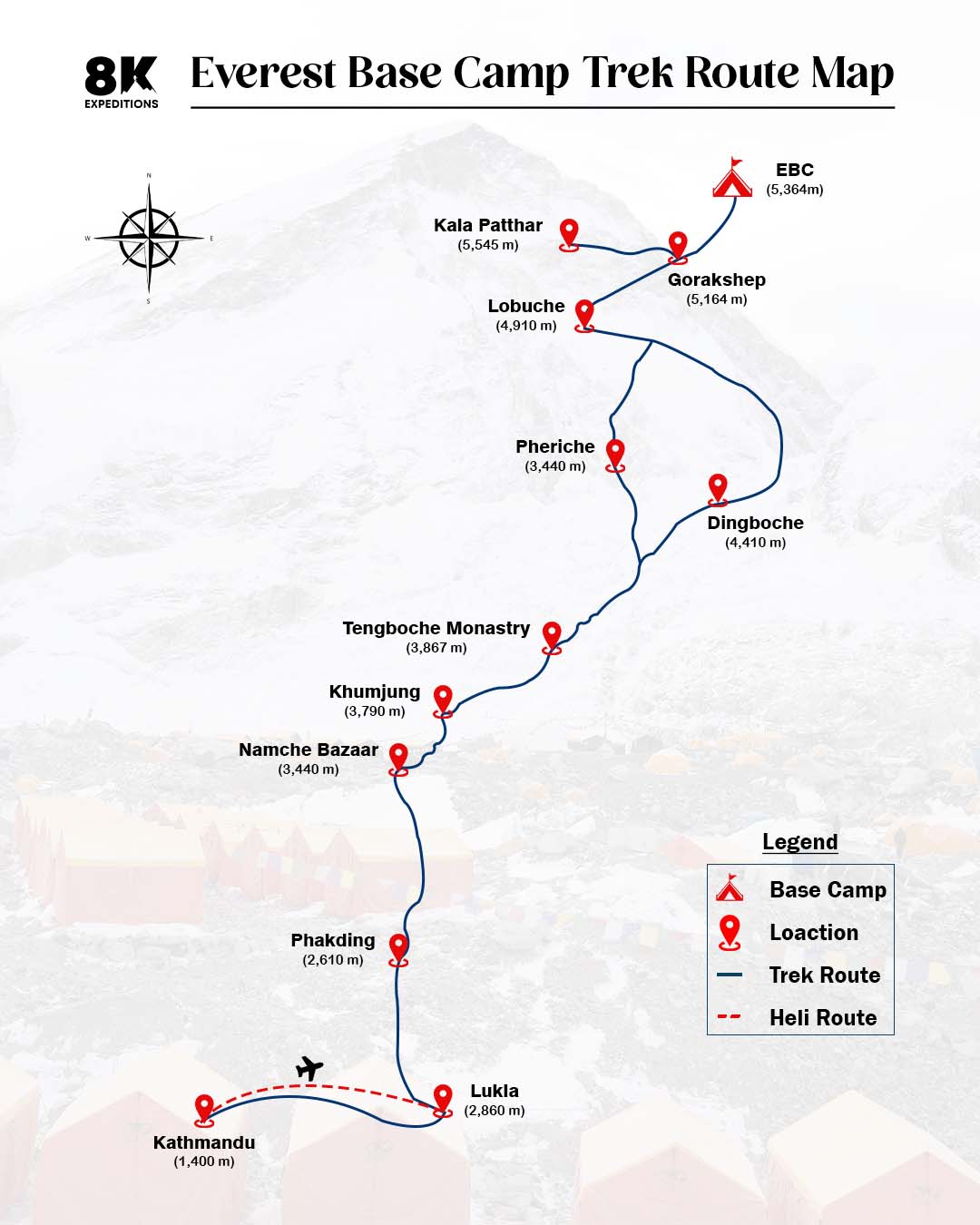
Everest Base Camp Trek Map
FAQs of Everest Base Camp Trek
What additional documents do I need?
Experience the ultimate convenience o
n your Everest Base Camp
trek with our carefully curated itinerary,
offering an EBC trek with helicopter return option.
Experience the ultimate convenience o
n your Everest Base Camp
trek with our carefully curated itinerary,
offering an EBC trek with helicopter return option.
Is hiring a guide necessary even if I have trekking experience?
Experience the ultimate convenience o
n your Everest Base Camp
trek with our carefully curated itinerary,
offering an EBC trek with helicopter return option.
Experience the ultimate convenience o
n your Everest Base Camp
trek with our carefully curated itinerary,
offering an EBC trek with helicopter return option.
What additional documents do I need?
Experience the ultimate convenience o
n your Everest Base Camp
trek with our carefully curated itinerary,
offering an EBC trek with helicopter return option.
Experience the ultimate convenience o
n your Everest Base Camp
trek with our carefully curated itinerary,
offering an EBC trek with helicopter return option.
Is hiring a guide necessary even if I have trekking experience?
Experience the ultimate convenience o
n your Everest Base Camp
trek with our carefully curated itinerary,
offering an EBC trek with helicopter return option.
Experience the ultimate convenience o
n your Everest Base Camp
trek with our carefully curated itinerary,
offering an EBC trek with helicopter return option.
I'm a Himalayan climber, summited few
8000m including Everest & Lhotse in
single season. I met Tshiring Jangbu Sherpa
in 2012 in Everest BC for the first time.
He was with other clients that time but he
did a nice job in fixing rope on Lhotse, a
strong and technical Sherpa. Same time he climbed
Lhotse without supplemental oxygen and it
was not his first time to do it!
Written May 10, 2025
Parvaneh Kazemi
Mountaineer
I'm a Himalayan climber, summited few
8000m including Everest & Lhotse in
single season. I met Tshiring Jangbu Sherpa
in 2012 in Everest BC for the first time.
He was with other clients that time but he
did a nice job in fixing rope on Lhotse, a
strong and technical Sherpa. Same time he climbed
Lhotse without supplemental oxygen and it
was not his first time to do it!
Written May 10, 2025
Parvaneh Kazemi
Mountaineer
I'm a Himalayan climber, summited few
8000m including Everest & Lhotse in
single season. I met Tshiring Jangbu Sherpa
in 2012 in Everest BC for the first time.
He was with other clients that time but he
did a nice job in fixing rope on Lhotse, a
strong and technical Sherpa. Same time he climbed
Lhotse without supplemental oxygen and it
was not his first time to do it!
 Russian
 French
 Spanish

 Accommodation